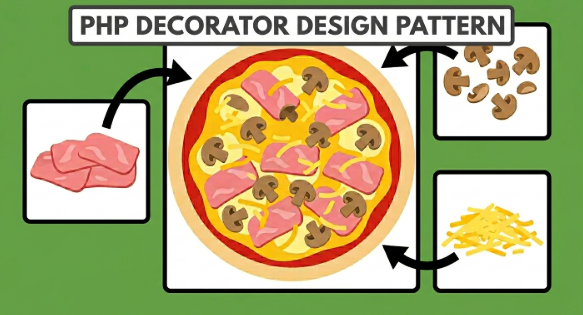
Hello developer 👋 In this post, we’re going to practice the Decorator pattern in a pizzeria 🍕 to add ingredients dynamically, without creating a class for each possible combination.
🍕 Act 1 — The starting point
As developers, we’ve created an application to manage a pizzeria. For now, it’s very simple and we only have a Pizza class that represents the only pizza sold, which gives us its description (Simple pizza) and its cost (5 euros):
class Pizza
{
    public function getDescription(): string
    {
        return 'Simple pizza';
    }

    public function getCost(): float
    {
        return 5.00;
    }
}

$pizza = new Pizza();
echo $pizza->getDescription(); // Simple pizza
echo $pizza->getCost(); // 5.00
💥 Act 2 — The problem grows
The business grows and the owner wants to offer extra ingredients. Our first idea as developers is to create a subclass for each variant, but with just 2 ingredients, we already need 3 classes. Adding more ingredients escalates the combinations: the code becomes unmanageable.
class PizzaWithCheese extends Pizza
{
    public function getDescription(): string
    {
        return 'Simple pizza, cheese';
    }

    public function getCost(): float
    {
        return parent::getCost() + 1.50;
    }
}

class PizzaWithHam extends Pizza
{
    public function getDescription(): string
    {
        return 'Simple pizza, ham';
    }

    public function getCost(): float
    {
        return parent::getCost() + 2.00;
    }
}

class PizzaWithCheeseAndHam extends Pizza
{
    public function getDescription(): string
    {
        return 'Simple pizza, cheese, ham';
    }

    public function getCost(): float
    {
        return parent::getCost() + 1.50 + 2.00;
    }
}

// ... and we keep creating classes 😰
💡 Act 3 — The solution
Let’s apply the Decorator pattern, which allows us to wrap a pizza with ingredients dynamically, without creating new subclasses.
// 1. Common interface
interface PizzaInterface
{
    public function getDescription(): string;
    public function getCost(): float;
}

// 2. Base pizza
class SimplePizza implements PizzaInterface
{
    public function getDescription(): string { return 'Simple pizza'; }
    public function getCost(): float { return 5.00; }
}

// 3. Abstract decorator
abstract class PizzaDecorator implements PizzaInterface
{
    public function __construct(protected PizzaInterface $pizza) {}

    public function getDescription(): string { return $this->pizza->getDescription(); }
    public function getCost(): float { return $this->pizza->getCost(); }
}

// 4. Concrete decorators
class CheeseDecorator extends PizzaDecorator
{
    public function getDescription(): string { return $this->pizza->getDescription() . ', cheese'; }
    public function getCost(): float { return $this->pizza->getCost() + 1.50; }
}

class HamDecorator extends PizzaDecorator
{
    public function getDescription(): string { return $this->pizza->getDescription() . ', ham'; }
    public function getCost(): float { return $this->pizza->getCost() + 2.00; }
}
PizzaDecorator is abstract for two reasons:
It doesn’t make sense to instantiate it alone; we always need a concrete decorator like CheeseDecorator.
It centralizes the common logic: the constructor that receives the pizza and the delegation of getDescription() and getCost(). Each concrete decorator only writes what it adds, without repeating code.
PizzaInterface is the contract that ensures everything that goes into a decorator — whether it’s the base pizza or another decorator — will always have the same methods. Without that contract, we couldn’t nest decorators.
✅ Act 4 — The result
$pizza = new SimplePizza();
$pizza = new CheeseDecorator($pizza);
$pizza = new HamDecorator($pizza);

echo $pizza->getDescription(); // Simple pizza, cheese, ham
echo $pizza->getCost();        // 8.50
🎯 Act 5 — Conclusion
Thanks to the Decorator pattern, we’ve gone from needing a class for each possible combination to needing only one class per ingredient. Adding a new ingredient is as simple as creating another decorator, without touching anything existing.
class PepperoniDecorator extends PizzaDecorator
{
    public function getDescription(): string { return $this->pizza->getDescription() . ', pepperoni'; }
    public function getCost(): float { return $this->pizza->getCost() + 1.80; }
}